Contents:
- Quick Answer
- Why Colour Matching Matters So Much
- The Basics: How Hair Colour Actually Works
- Level, Tone and Depth
- Your Hair Is Not One Colour
- Why Lighting Changes Everything
- Colour Matching Hair Extensions for Different Looks
- Solid Colours
- Highlights and Lowlights
- Root Smudge
- Balayage Hair Extensions Explained
- Balayage Matching Checklist
- Ombre vs Balayage: Two Terms People Confuse
- Intermediate Level: Blending Multiple Shades
- Warm vs Cool Undertones
- Colour Matching Curly Textures
- Curly-Specific Colour Tips
- Advanced Nuances: Toning, Fading and Ageing
- Colour Does Not Stay Still
- Cool Tones Fade to Warm
- Dyeing Extensions
- Seasonal Sun Effects
- Finding the Right Salon for Colour Work
- How a Colour Match Is Done, Step by Step
- A Story From the Colour Chair
- Colour Matching for Grey, Blonde and Fashion Shades
- Grey and Silver
- Blonde
- Fashion Colours
- What Colour Services Cost
- Aftercare for Coloured Extensions
- Hard Water and Colour
- Why Specialist Colour Knowledge Matters
- Common Mistakes in Colour Matching
- Frequently Asked Questions
- Can I match extensions to hair that is already highlighted?
- Is balayage better done before or after fitting extensions?
- Do curly extensions look darker than straight ones?
- How often should extension colour be refreshed?
- Can I colour my extensions at home?
Colour matching hair extensions is the part of the process where most sets are made or ruined, and it has very little to do with picking a shade from a chart. A swatch on a card tells you almost nothing about how that colour will behave against your roots, your highlights and your daylight. The reality is a bit more interesting, and a lot more forgiving, once you know what the colourist is actually doing.
Here is the claim worth testing: a perfectly matched set should not look “matched” at all. Nobody should be able to spot where your hair stops and the extensions begin, not in the salon, not in a car park at noon. Getting there takes some understanding of how hair colour is built, how balayage and ombre differ from a flat shade, and why curly textures change everything.
Quick Answer
Quick Answer: Match the colour of the mid-lengths and ends, not the roots, since that is where the extensions will sit. For balayage and ombre, choose extensions with a similar gradient or have them hand-painted after fitting. For curly hair, check the shade on a curled sample in daylight, because curls read darker than straight strands. Expect to need two or three tones blended for a natural result, and ask for a toner appointment if the first fitting is close but not perfect.
Why Colour Matching Matters So Much
The eye notices differences in colour faster than almost any other detail. A shade that is half a tone too warm can make a perfect fitting look like a clip-on accessory. Beyond looks, poor matching causes practical problems: extensions that clash tend to get hidden under the top layer, which means more weight at the nape and less use of the length you paid for. Getting the shade right lets the stylist place hair where the style needs it, not where the mismatch can be concealed.
There is also a financial reason. Fixing a poor match later means toning, glossing or recolouring the hair, and each of those costs money and wears the extension hair a little more. A careful match at the start is cheaper than any correction, which is why Ivana Farisei treats the colour consultation as a billable skill and not a formality.
The Basics: How Hair Colour Actually Works
Level, Tone and Depth
Colourists describe hair on two scales. Level measures lightness from 1 (black) to 10 (the lightest blonde). Tone describes the undertone: warm (gold, copper, red), cool (ash, violet, blue) or neutral. Two shades at the same level can look completely different if one is warm and the other cool. Matching the level gets you most of the way there, and matching the tone does the rest.
Your Hair Is Not One Colour
Look at your hair in a window. The roots are usually darker, the mid-lengths lighter, and the ends lightest after months of sun and washing. Even without colour treatments, natural hair has variation. If a set of extensions is a single flat shade, it will look like a block of paint on a gradient. This is why professionals often use two or three colours in the same set.
Why Lighting Changes Everything
Salon lights tend to be warm and bright, which flatters most shades. Daylight is cooler and shows undertones more clearly. A colour check by a window, ideally with a sunny or bright overcast sky, reveals problems that salon lighting hides. If your stylist does not offer this, step outside for a minute with a mirror.
Colour Matching Hair Extensions for Different Looks
Solid Colours
A single shade, whether natural brown or an all-over blonde, is the simplest to match. The task is to find the level and tone that fit the mid-lengths of your hair, then blend the root with a slightly darker tone. Even with a solid colour, stylists often add one or two accent strands for dimension.
Highlights and Lowlights
Foil highlights create stripes of lighter colour at regular intervals. Matching them means choosing extensions with similar striping, or tinting a base shade afterwards. Highlighted hair also tends to be more porous than the extensions, so toning after fitting is common.
Root Smudge
A darker root, blended downward, is a favourite trick for making extensions look as if they grow from the scalp. It also softens the transition between natural and added hair, which is especially useful when your natural colour has grown out.
Balayage Hair Extensions Explained
Balayage is a freehand painting technique in which colour is swept onto the surface of the hair to create soft, graduated brightness. It has no regular stripes and no hard lines, which is the reason it looks natural and the reason it is harder to match than a flat shade. Extensions for a balayage client need to carry the same soft transition from darker at the top to lighter below, with the brightest areas falling in the right places.
There are two ways to achieve this. The first is to buy pre-coloured, gradient extensions in a shade close to your own. The second, often better, is to fit lightly coloured extensions and then hand-paint the balayage across both natural and added hair, so the two blend together. Specialists who handle balayage hair extensions regularly tend to prefer this method for demanding colours, because it lets them respond to the actual hair in the chair rather than a catalogue image.
Balayage Matching Checklist
- Match the mid-length tone first, then the lightest ends.
- Keep roots 1 to 2 levels darker than the mid-lengths for a natural gradient.
- Plan the placement of lighter pieces around the face, where they have the most effect.
- Expect a gloss or toner appointment after fitting to unify the finish.
Ombre vs Balayage: Two Terms People Confuse
The words are often used as if they mean the same thing, and some hair websites mix them up. They are different techniques with different outcomes, and the difference matters when ordering extensions.
- Ombre is a deliberate, visible gradient from dark roots to light ends. The transition is usually horizontal and fairly even, like a fade, and the contrast is clear. It is bolder and more graphic.
- Balayage is painted in a freehand style with softer, scattered brightness. The effect is a sun-kissed finish with no obvious line.
- Highlights are more uniform sections of lighter colour, usually placed with foils and spaced evenly.
Ombre extensions need a clean, even gradient that lines up with the height of your own transition. If the dark-to-light shift on the extensions starts at a different point than yours, the result looks like two separate colours stacked on top of each other. Balayage is more forgiving because the softness hides small differences.
What the Pros Know: Always match the extension gradient to your hair, not the other way round. It is far easier to adjust the extensions by tinting or glossing than to change your natural colour. Ask the stylist to hold sample strands against your hair at the point where your colour changes, and judge the match there.
Intermediate Level: Blending Multiple Shades
Real hair rarely falls into one colour band, and blending several shades in a single set is the usual way to reproduce that variation. A typical blend for a dark brown base might use three tones:
- A deep shade (level 3) for the root area and underside.
- A medium shade (level 5) for the mid-lengths.
- A lighter shade (level 6 or 7) for the ends and face-framing pieces.
The stylist then places the strands to follow the pattern of your own hair, with lighter pieces on the top layer and darker underneath. This is the principle behind a custom-coloured set, and it explains why a ready-made single colour often looks flatter.
Warm vs Cool Undertones
Undertone is the most common source of mismatch. A warm golden extension on cool ash hair will glow orange in sunlight. The reverse looks flat and grey. To check, hold the sample strand against your hair in daylight and look for the colour that stands out in the shadow of the strand. If it looks yellow or copper, it is warm. If it looks blue, green or ashen, it is cool.
Colour Matching Curly Textures
Curly and coily hair does not reflect light in the same way as straight hair. The surface of each curl catches light on the outside and loses it in the gaps between loops, which makes curly hair look darker and richer. A swatch held flat will mislead, and a straight sample may look a tone lighter than it appears once curled.
For clients searching for extensions for curly hair, the colour check has to be done on a curled sample, ideally the same pattern that will be fitted. Place it against your hair in daylight and look at both the surface and the shadow beneath. If it still blends, you have found the match.
Curly-Specific Colour Tips
- Choose a shade one level lighter than the straight swatch, since curls read darker.
- Add depth at the root with a darker tone to mimic the natural shadow of a curl.
- Use glossing treatments to even out shine, because curly extensions often look glossier than natural curls.
- Avoid heavy bleaching on extensions, as curly hair is more fragile and can lose its pattern when over-processed.
- Check the colour after the set has been washed and styled, as the curl pattern may change its appearance.
Advanced Nuances: Toning, Fading and Ageing
Colour Does Not Stay Still
Your hair will fade, grow out and lighten in the sun. Extensions will fade too, but at a different rate, because they do not receive scalp oil or the natural pigment replenishment of growing hair. Within eight to twelve weeks, a perfect match can drift by a tone. This is normal and can be corrected with a gloss or toner at the maintenance visit.
Cool Tones Fade to Warm
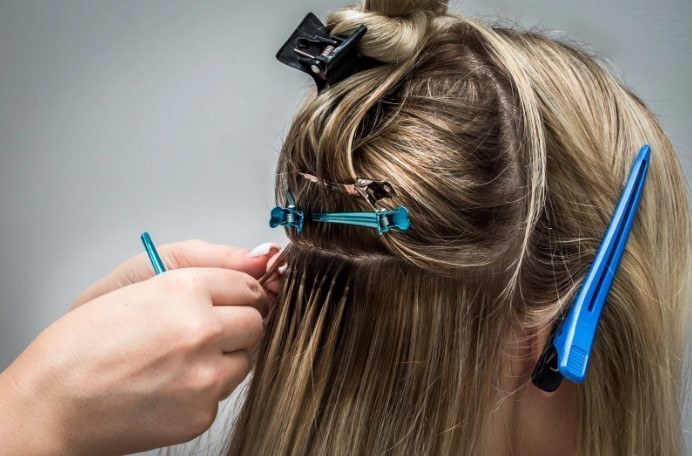
Ash and silver tones are the least stable. They tend to fade to yellow or brassy within weeks, particularly with hard water. A purple shampoo once a week keeps them in check, and a toner at each refit refreshes them.
Dyeing Extensions
Human hair extensions can be coloured, but only in one direction: darker or slightly lighter, not dramatically lighter. Extension hair is often already processed in the factory, and further bleaching weakens it. Bleaching it to a blonde from dark brown rarely works, so start with the closest natural shade and adjust from there.
Seasonal Sun Effects
Summer sun lightens natural hair by up to a tone or two, which means a match made in winter may look darker by August. Plan a toning session or a refit in summer, and use UV-protecting hair products if you spend time outdoors.
Finding the Right Salon for Colour Work
Colour matching is a skill that grows with repetition. Choose a salon that colours and fits extensions under the same roof, as it removes the risk of two different professionals blaming each other if the result is off. Among the hair extension salons london clients can choose from, the practical differentiator is whether the stylist treats colour as part of the fitting process or as a separate add-on.
At Ivana Farisei, colour is discussed at the consultation and checked again after fitting, in daylight. That second check matters, since the first impression in a salon chair is rarely the one you will see at a bus stop. The team will also tone the hair in the days after fitting if a difference shows, which is a service many salons treat as an extra.
How a Colour Match Is Done, Step by Step
Understanding the sequence helps you judge whether a salon is doing it properly. A thorough colour match is a process with several checks, not a single decision.
- Read the natural hair. The stylist examines the root, mid-length and ends separately, noting level and tone at each point.
- Select candidates. Two or three shades are picked from the colour ring or from the stock, and held against the hair in different spots.
- Check in daylight. The client moves to a window, where undertones show up more clearly.
- Blend the set. If no single shade works, the stylist plans a mix of two or three, often with a darker shade for the underside.
- Fit a test section. Some salons fit a few strands before continuing, to confirm the match.
- Check after fitting. The finished set is viewed from all angles, in daylight again.
- Tone if needed. A gloss or toner nudges the colour into place.
Salons that skip steps 3 and 6 are the ones where clients later say “it looked right in the chair.” A match is only finished when it has survived daylight.
A Story From the Colour Chair
A client, whom we will call Sofia, arrived with soft caramel balayage that had faded over six months. She wanted length, and she wanted nobody to know. The first instinct was to pick a caramel shade from a ring. The stylist held it against her hair and the difference was obvious: Sofia’s mid-lengths had gone slightly ashy from hard water, while the caramel sample was golden.
The fix was a three-part plan. A softer, cooler honey shade for the body of the set, a lighter piece for the face, and a darker blend at the root. After fitting, the stylist painted a few fine highlights across the join and applied a gloss. Under the salon lights it looked fine. In daylight, it looked like her own hair on its best day. That is the standard to aim for.
Colour Matching for Grey, Blonde and Fashion Shades
Grey and Silver
Natural grey is rarely one colour. It is a mix of white, silver and the original shade, and it varies from the temples to the crown. A set of extensions for grey hair usually blends three tones, and a purple toner keeps yellowing at bay. Grey is also the colour where a mismatch is most obvious, so extra care is worth taking.
Blonde
Blonde is the most demanding shade because small differences in tone show up as brassiness or ashiness. Extensions are usually lifted from lighter bases and toned to match, with roots left slightly darker for depth. A refit every eight weeks gives the opportunity to re-tone.
Fashion Colours
Pinks, blues and coppers can be added with coloured extension strands, but they fade quickly. A few accent pieces are a lower-commitment way to try a bright shade, and they can be removed or replaced without touching the rest of the set.
What Colour Services Cost
Colour work adds to the price of a set, so it helps to budget for it. As a rough guide for UK salons in 2026:
- Colour consultation: free to £30, often credited against the booking.
- Toner or gloss on extensions: roughly £35 to £80.
- Hand-painted balayage across a fitted set: roughly £120 to £300 depending on length.
- Custom-blended or pre-coloured extension hair: a premium of £30 to £150 over standard shades.
These are indicative ranges and not a quote, and the cost should be confirmed in writing before the appointment. If a salon offers colour matching free of charge but limits the shades you can choose, that may suit a simple look, though it is rarely enough for balayage or a gradient.
Aftercare for Coloured Extensions
The shade you leave the salon with is not the shade you will have in three months unless you protect it.
- Use a sulphate-free, colour-safe shampoo, and wash with lukewarm water.
- Apply purple shampoo once a week on blonde or ash tones, leaving it for two or three minutes at most.
- Use a UV-protecting spray in summer, and wear a hat on bright days.
- Keep heat tools below 180°C and always use a heat protectant.
- Rinse after chlorine or sea water, since both strip colour and add a tint.
- Book a gloss at each maintenance visit to refresh shine and tone.
Hard Water and Colour
Hard water leaves mineral deposits that dull colour and create a brassy tint. Londoners are used to this, since the city sits on chalk and has some of the hardest water in the country. A shower filter or a monthly chelating shampoo makes a visible difference, particularly for lighter shades.
Ivana Farisei advises clients with London postcodes to treat hard water as part of the colour plan. A mineral build-up that looks like fading is sometimes solved with a single clarifying wash rather than a new toner, which saves both money and processing.
Why Specialist Colour Knowledge Matters
Colour work on extensions differs from colour work on natural hair. The hair has no blood supply, it holds dye differently, and it cannot be re-pigmented from the root. A stylist who colours natural hair every day but rarely works with extensions can misjudge how much a tint will lift or deposit. In practice, this is the reason many people choose a salon that handles both fitting and colouring: the same person knows how the hair will behave and can plan the entire look from the start.
The team at Ivana Farisei colours, fits and tones in one place, which also means that if a shade drifts in the first month, the person who chose it is the person who fixes it. That continuity is rare and makes a measurable difference to how closely the final result matches the plan.
Common Mistakes in Colour Matching
- Matching the roots. The roots are usually darker and are hidden by the extensions. Match the mid-lengths instead.
- Relying on the screen. Online colour swatches vary with every device. A sample in hand beats a photo.
- Judging in salon lighting only. Always check in daylight.
- Using a single flat shade. Natural hair has variation, and a flat shade stands out.
- Ignoring undertone. A level match with the wrong tone looks off.
- Buying cheap hair that cannot be toned. Low-quality hair often has a coating that resists colour and fades unevenly.
- Skipping the aftercare. Purple shampoo, UV protection and gentle washing keep the match intact.
Frequently Asked Questions
Can I match extensions to hair that is already highlighted?
Yes. The stylist will usually blend two or three shades, or apply toner after fitting, so the highlights continue through the extensions.
Is balayage better done before or after fitting extensions?
For a seamless result, most specialists apply the balayage after the extensions are fitted, so the painting runs across both. If your hair is already balayaged, the extensions can be toned to match.
Do curly extensions look darker than straight ones?
Yes. Curls absorb and scatter light differently, so the same shade usually appears deeper and richer in a curled pattern. Always check colour on a curled sample.
How often should extension colour be refreshed?
Every eight to twelve weeks, at the same time as a maintenance visit. Cool tones may need toning more often.
Can I colour my extensions at home?
It is not advised. Extension hair reacts differently from natural hair, and an uneven result is hard to fix. A professional can tone or tint safely and will know the limits of the hair. Ivana Farisei offers gloss and toning appointments for exactly this reason, so fading never has to be solved with a box dye.